Monday, April 26, 2010

Englische Schafstelze bei Leimen

Summary (from my comment on 10,000Birds)
On April 25th 2010, the fields formerly known as the Boredom Flats have been re-named Motacilla Catwalk.
I had a great weekend filled with amazing birds, about which I will surely blog, but most memorable was a large-ish flock of Yellow Wagtails that actually contained three species (yes, ALL forms of the Yellow Wagtail are recognized as separate species in Germany - lucky me):

The usual flavas, one fine male thunbergi and a sparkling flavissima (”English Yellow Wagtail”, with apologies to the Scots, Welsh, and Irish).
This post is just to show (off) the amaaaazing photos I took of the flavissima to some German friends and enviers, therefore the rest is in German.


Am 25.04.2010 konnte ich auf den frisch bestellten Ackerflächen am Südrand von Leimen (südlich Heidelberg) zwischen einigen Wiesenschafstelzen (8,4 - am Vortag 27) und einer Thunbergschafstelze (1,0 - wobei zwischen den Weiblichen flava ja auch die eine oder andere weibliche thunbergi hätte sein können) auch eine Englische Schafstelze flavissima beobachten.

Das fand ich sehr nett.

Im Folgenden ein paar rottige Belegfotos sowie Angaben zum Beobachtungsort.


Beobachtungshinweis zur Schafstelze:
Am Besten man fährt zu den Tennisplätzen und parkt auf dem großen Parkplatz vor der Turnhalle. Dann geht man den Fußweg am südlichsten Tennisplatz entlang bis auf die Ackerflächen (vielleicht 100m). Die Schafstelzen wechseln mal hin, mal her, aber von diesem zentralen Weg aus kann man nach links und rechts die Flächen wohl am besten absuchen.
Auffallend an dem Vogel - "auffallend" ist aber relativ verglichen zu flava-Weibchen - ist die praktisch rein grüne Oberseite, mit nur leichter Aufhellung am Oberkopf und die recht kräftig gelbe Unterseite einschließlich der Kehle. Der Überaugenstreif ist eindeutig gelblich, wenn auch etwas heller als das Gelb der Unterseite. Es ist eine flava (Weibchen) dabei, die auf der Oberseite ähnlich grünlich ist, hat aber einen deutlich weißen Überaugenstreif und auch mehr weiß an der Kehle. Man muss aber aufpassen, und ich habe z.B. einmal glatt beim Anfertigen der (sehr schlechten, siehe unten) Belegfotos das falsche Weibchen "verfolgt".


Der Beobachtungsort - und auch ein Original der Belegfotos um zu verdeutlichen, wie sehr die folgenden Bilder vergrößert bzw. "gecropped" sind. Die Stelze ist links etwas unterhalb des grünen Flecks im Zentrum


gelbe Kehle


Sunday, April 25, 2010

Abweichend rufender Zilpzalp bei Heidelberg

Summary: Chiffchaff with an aberrant call
A Chiffchaff with a known form of aberrant call was encountered near Heidelberg on April 24th, 2010. While birds with this type of call can be found a few times each year, this is the first time I managed to take some photos. These are presented here, along with a few notes on the observation to hopefully help clarify the origin of this strange call in Chiffchaff.


Am Morgen des 24.04.010 konnte ich an den sog. Aussiedlerhöfen zwischen Nussloch und Leimen (südlich Heidelberg) einen Zilpzalp mit dem bekannten abweichenden Ruf (auf- und wieder absteigendes, "wellenförmiges" suuIIIuu) beobachten und fotografieren. Neben den Fotos werden im Folgenden ergänzende Angaben zur Beobachtung gemacht, die hoffentlich dazu beitragen mag, Herkunft und Ursache des abweichenden Rufs zu klären.

Ich beobachte regelmäßig in diesem Bereich, d.h. bin dort insbesondere am Wochenende mehrmals täglich unterwegs . Vor dem 24.04. war mit Sicherheit niemals der abweichende Ruf in der weiteren Umgebung des Beobachtungsorts zu vernehmen.

Ob am Beobachtungsort selbst auch zuvor ein Zilpzalprevier war, kann ich nicht sagen. Ich kartiere nicht systematisch, und der Zilpzalp ist in der Heckenlandschaft der Umgebung sehr häufig, ich nehme ihn also nicht besonders war und merke mir die Reviere nicht.

Am Nachmittag des 24.04. sowie am 25.04. war der Vogel nicht zu hören, am 25.04. jedoch nicht unweit (50 - 100 m entfernt vom Beobachtungsort) der normale Gesang eines Zilpzalps.

Bemerkenswert erscheint mir, dass dies meine erste Begegnung mit solch einem "Abweichler" dieses Jahr ist, einen guten Monat nach der (massenhaften) Ankunft des Zilpzalps. Ich achte speziell auf diesen abweichenden Ruf und konnte ihn im Sommer 2009 mehrfach bei Heidelberg hören, bin also entsprechend sensibilisiert. Es handelte sich bei der Beobachtung am 24.04. somit definitiv um die bisher einzige Beobachtung und das erste Auftreten des Sommers 2010.

Der rufende Vogel wurde über etwa 10 Minuten beobachtet. In dieser Zeit wurde kein weiterer Laubsänger in der Umgebung gesehen. Er rief während der gesamten Beobachtungszeit kontinuierlich, und sicher auch noch danach, da ich das Gebiet vorzeitig verlassen musste.

Während der gesamten Beobachtungszeit wurde ausschließlich dieser Ruf vernommen, kein typisches "huid" und kein normaler Zilpzalpgesang. Der Ruf wurde die gesamte Zeit über in festem, gleichmäßigen Takt geäußert, ganz grob ein Ruf pro Sekunde.

Welche Funktion der Ruf hatte, ist schwer zu sagen. Ich gehe nicht von einem Warnruf aus, da der Vogel dazu zu lange rief und vor allem unvermindert rief, auch nachdem ich über 20 m entfernt war (sowohl der Vogel als auch ich bewegten sich vom ursprünglichen Beobachtungsort fort). Auch würde ich bei einem Warnruf ein unregelmäßiges Rufen vermuten, mit kleinen Pausen dazwischen und Phasen erhöhter Rufaktivität. Das war nicht der Fall, es war ein monotones, permanentes und taktfestes Rufen. Rein intuitiv wirkte das auf mich eher wie Gesang!
Hier nun die Bilder, ich habe lieber mal ein paar mehr hochgeladen, auch wenn viele im Prinzip identisch sind.

Bei Bedarf kann ich die Bilder in höherer Auflösung per Email weiterleiten. Gerne beantworte ich auch weitere Fragen, falls jemand dem Phänomen noch immer auf der Spur ist!


Wednesday, April 21, 2010

Schildkröten - Turtles


English
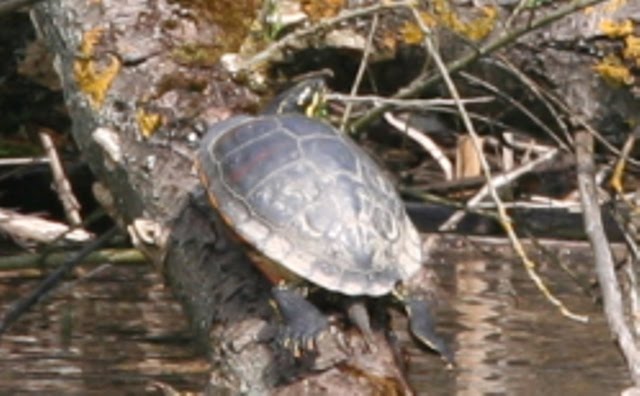
The following two species of turtle were observed in Germany, just south of Karlsruhe, on the edge of a reedy pond surrounded by trees. They are certainly both released pets and thus could be from anywhere, but I'd guess they are most likely North American species.
Any thoughts on their ID would be highly appreciated.


Deutsch
Die folgenden Aufnahmen zeigen zwei Schildkröten (unterschiedliche Arten), die an einem Baggersee südlich von Karlsruhe beobachtet wurden. Natürlich sind es ausgesetzte Haustiere, und es würde mich sehr interessieren, zu welchen Arten sie gehören. Hinweise zur Bestimmung sind daher mehr als willkommen.


Tuesday, April 6, 2010

Danged Phyllo

At first I thought I had simply seen one too many North American wood-warblers and that this had rendered me - and only and specifically me - unable to satisfactorily tackle one of the most basic identification exercises in Europe: the differentiation of Willow Warbler and Chiffchaff.


However, upon communicating with other far more experienced birders over the pictures, opinions had ranged from Chiffchaff to as far as Willow Warbler, so either we have all - here in Europe - seen one too many North American wood-warblers or the bird on the pictures (or the pictures themselves) aren't that straight-forward.


Whatever the case may be, I'd be very interested in YOUR opinion as to the bird's identity and if you'd also include a "why" in the "what" (or rather "who"), I'd be thrilled.


Without further ado, here are the pictures:


Wednesday, February 24, 2010

A bit on Sandhill Cranes

Nate recently brought up the question (see the comments section) whether the Sandhill Cranes breeding in Michigan's Upper Peninsular belong to the Lesser or Greater group.

This is actually not insignificant as DNA analyses support a distinctness of the two forms that might lead to them being recognized as separate species one (fine) day.

Having only seen them there and in southern Michigan, I began investigating a bit, although none of the material presented here needed a huge amount of investigation, frankly.

First up, here's a picture (digitalized slide) I took of a Sandhill Crane around the middle of May 2005 on the Upper Peninsular of Michigan:


Wikipedia offers a nice overview of the different forms here.

The most interesting site however was the International Crane Foundation's Sandhill Crane entry which offers a very fine map of the basic migration routes (I can't link there directly, just click it).

Apparently Michigan is only visited by the Greater form, Grus canadensis tabida, both during the breeding and migration season. I am however not entirely sure where the Canadian Sandhill Crane, Grus canadensis rowani, fits in - a form that is apparently intermediate between Greater tabida and Lesser canadensis.

As a matter of fact, the only information I found about rowani is that its subspecific status is in question as it might form some sort of cline between Greater and Lesser.

One of the best places in SE Michigan for watching cranes (alas, I was not to visit it while I was in Ann Arbor) is Phyllis Haehnle Memorial Audubon Sanctuary. According to their "Crane facts", the subspecies occurring there is the Greater Sandhill Crane tabida, so I guess we just ignore rowani for the time being and are happy and satisfied that the Michigan Sandhill Cranes, no matter what the season, are Greater Sandhills.

Which means I really ought to visit the Platte one fine day...

Cheers, Michigan!

Wednesday, November 25, 2009

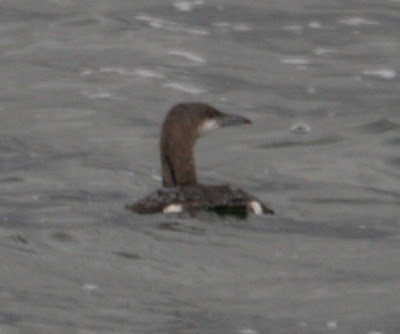
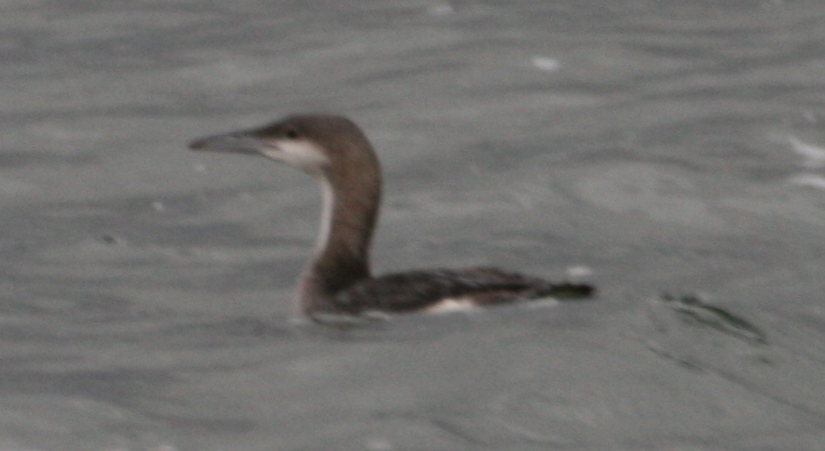
A mystery diver

UPDATE
I was always a bit skeptical about this bird being a Common Loon / Great Northern Diver, but equally skeptical about it being an Arctic Loon / Black-throated Diver. Many features of Great Northern are clearly missing, while some features do not match Black-throated. I find the colouration on the back of the neck particularly significant as it apparently does not occur in Black-throated but can be explained by moult and feather aging when we call the bird a Great Northern.
However, my current hypothesis is a different one: this bird might be a Black-throated Diver of the Siberian subspecies viridigularis (I am NOT talking about the Pacific Diver!).
This subspecies is considerably larger than the nominate Black-throated and has a more Great Northern "feel" to it. Furthermore, I have checked the Internet for pictures of viridigularis and it might be possible that this form does occasionally show the neck pattern that has me so confused.

Here are some links I found.

Birds presumably belonging to viridigularis:
here, here (scroll down for two more pics), here, here.

Interesting identification articles here, here.


Preface
Bird names again. Although I returned to the old stompin' grounds of the Olde Europe quite some time ago now, I am aware that this (or rather its big brother Belltower Birding) is still largely a North American blog. Therefore, whenever there is a discrepancy between the North American and the British name for a bird, I am perplexed.
I have now decided to follow the following rule:
When there are two differing names for the same species on both sides of the Atlantic, I will use the one of the side the blog's story is centred on. Therefore, if I blog about Gavia immer in North America, I'll write about the Common Loon, but if my blog post is about an observation of Gavia immer from the coasts of Europe, I'll refer to it as Great Northern Diver.

This post is thus about a potential Great Northern Diver (= Common Loon) and the potential identification pitfall, the Black-throated Diver (= Arctic Loon).
Geez, this was a long and complicated thing. I really wish you guys could pull yourselves together and agree on internationally valid English names for the birds of the world.


Okay, here's the thing this is all about:


Main Story
As I haven't told you already, I spent three enjoyable weeks vacationing on the German Baltic coast, mostly the lovely small town of Binz on the island of Rügen at the end of October / beginning of November 2009.

Right at my first day at the Binz jetty at the end of October, I noticed a diver (Gavia, you know, a blinkin' LOON if you so wish) that was pretty close. Expecting it to be a Black-throated, not an uncommon sight there but always nice to see, I completely focused on taking pictures with my shabby Sigma 70-300 mm (look, it's not shabby for the low price I had to pay for it, but it sure ain't no Canon and it doesn't exactly outperform itself at distances of more than 10 metres. Close-ups are okay though, see my Crane Creek pictures from May and June 2007).

After bringing his majesty Young Belltower Birder to bed that same evening, I sat down, enjoying the calm and checking out my Black-throated diver pics on the display of my camera. Immediately upon zooming in, I noticed the huge fat bill, fit to seriously kick some fish butt, and the peculiar pattern on the pale grey-brown nape: a black half-necklace (not reaching onto the white throat) with a very thin yet precisely defined black line up the neck towards the crown.

This really smelled like a Great Northern Diver, a species however that is extremely rare along the Baltic coast of Germany (although it is seen on off-shore surveys rather frequently, I am not aware of observations from the coastline each year and would guess one shows up in coastal waters every three years or so).

I was able to watch it frequently - whenever I was able to pull myself away from the shops (or rather get away from my wife at the shops?) - until I left Binz in the first days of November.
In case you want to see it yourself, I am sure it is still there and the flight from, say, New York to Berlin will take around 10 hours plus a three and a half hours drive to Binz, let me see, dang, you could be there tomorrow - easily.

Jocking.


Now, upon checking my pictures more thoroughly on a laptop monitor, I am still rather convinced it is a Great Northern Diver, yet a few things don't add up, so here are my thoughts on its identification:

It clearly is a juvenile bird.

Features of a Great Northern Diver I do not see, or features that would support an ID as a Black-throated Diver:

a) The bill is strong and appears a bit too strong to be within the variation of Black-throated, yet it appears slightly down-curved which is a feature I associate more with Black-throated than with Great Northern.

b) The head profile is very flat and does neither show the steep forehead, nor the "bump" of the Great Northern.

c) The feature Sibley refers to as "jagged neck marking", an indentation of the white forehead into the dark nape, is completely missing. However, the whitish cheeks do extend into the dark nape somewhat, which is a feature associated with Black-throated.

d) There is no white around the eye.

e) There is a white patch on the rear flanks which suggests Black-throated rather than Great Northern.


Well, after reading this one might wonder just what has me still convinced it is a Great Northern Diver? And rightly so as well. So here are my points in favour of the rarity:

a) That bill is a huge thing, really impressive, downcurved or not.

b) I hardly ever saw the bird in direct comparison to other water birds, and judging size at sea is a near impossibility. However, its movements when diving were impressive, much like a submarine and not a bird at all. I once had it rather close to a swimming cormorant (Phalacrocorax carbo sinensis) and the mystery Gavia did appear significantly larger than it, I would say the body appeared almost double the volume of the cormorant, but there was no direct comparison, not a side-by-side thing in the same field of vivion, so I could be wrong - but I strongly doubt that I am.

c) The colouration of the hind neck / nape, with a black semi-necklace and that black line going up the nape's centre towards the crown is - in my opinion - a very strong argument for Great Northern.

Okay, now it is your turn:
I would strongly appreciate any kind of opinion on the bird's identity (preferably containing not only the what but also the why).
I would like to particularly encourage those to speak out who are in favour of it being a definite Pacific Diver, a first for Germany and a lifer for me - although I know it is not. But you know, in some cases I can be quite a push-over...

Jocking. Again.

Thank you, cheers and settle on some pan-Atlantic bird names, will you?


Oh yeah, here - finally - are the pictures

Picture of the peculiar neck colouration:


Throat view, no dark necklace but that could be photo-shopped if the rest fits Pacific Diver.
You know - yet again: Jocking. Of course.


Tons of profile shots:


Gavia-loonish mystery diver doing its best Shakin' Stevens personation (he's never where he's needed the most).


Thursday, June 25, 2009

Fish / Fisch

This is a very strange fish I encountered in the Saint Petersburg area of Western Russia, and I'd really like to know what species it is.
It - along with a small number of its kind - lived in a shallow, nutrient-poor and thus crystal clear small lake (diametre less than 30 metres) .


Diesen seltsamen Fisch habe ich in geringer Anzahl in einem sehr kleinen (Durchmesser 30 m) nährstoffarmen und daher kristallklaren felsigen Flächgewässer bei St. Petersburg beobachtet. Vielleicht kann mir jemand per Email oder in der Comments - Sektion mitteilen, um was für eine Art es sich handelt?
Besonderheit: er bewegte sich wie ein Kugelfisch schwebend, ausschließlich über die Bewegungen der Brustflossen und zeigte nicht das für viele Fische typische Schlängeln.

Besten Dank im Voraus!